
You’ve booked your first jiu jitsu class. Now you’re nervous.
What do you wear? Where do you go? Will you be the only beginner? What if you can’t keep up?
I’m going to walk you through exactly what happens at your first class at Partizan Grappling in Kingsford, step by step, so there are no surprises.
Before You Arrive for your First Jiu Jitsu Class
What to wear: Shorts without pockets or zippers, and a fitted t-shirt or rashguard. That’s it. No shoes on the mat. Bring flip-flops to walk around in.
Don’t own athletic shorts without pockets? Just wear whatever comfortable shorts you have. Nobody cares on your first class.
What to bring: Water bottle. Maybe a small towel. That’s all.
When to arrive: Arrive 10-15 minutes early. This gives you time to fill out paperwork, meet the instructor, and not feel rushed.
Getting here: Partizan is at 381 Anzac Parade in Kingsford, right near UNSW. Free street parking on Anzac Parade and surrounding streets. If you’re taking public transport, it’s a 10-minute walk from UNSW, or catch the 391, 392, 393, 394, 395, or 396 buses along Anzac Parade.
Walking Through the Door (6:50 PM)
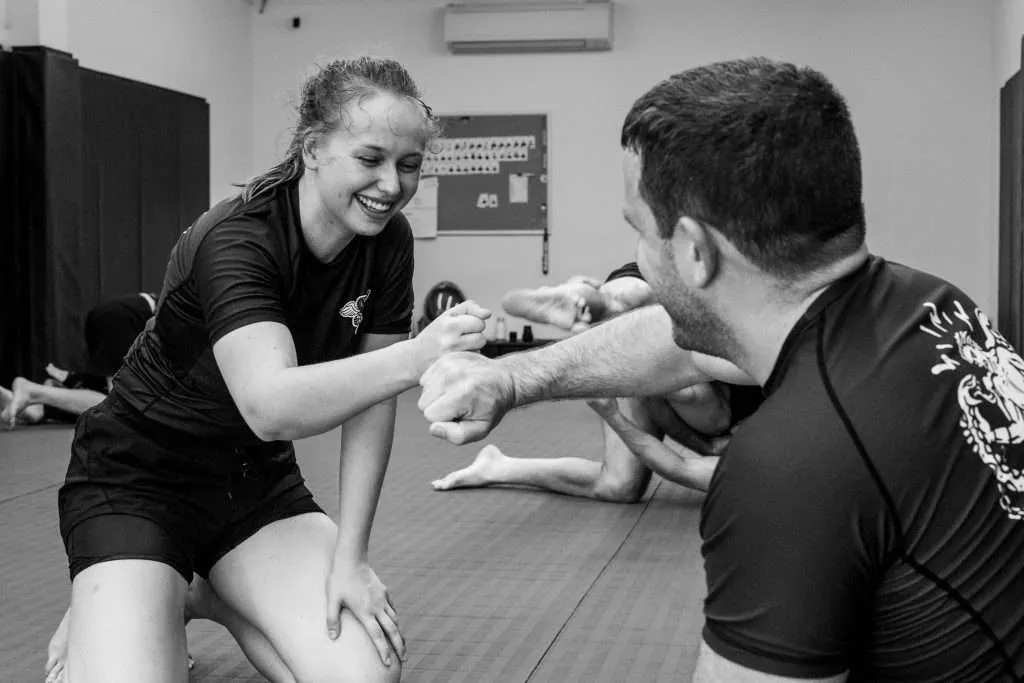
You walk in and see the mats stretched across the floor. A few people are already warming up, rolling their shoulders, stretching their hips. The vibe is casual. No one’s in matching uniforms doing synchronized movements.
Someone (probably one of the coaches) greets you. They’ll ask if it’s your first time. You say yes. They show you where to put your shoes and bag.
You see people warming up, stretching, chatting. Some wear rashguards with sponsor logos. Some are in regular gym clothes like you. Nobody’s looking at you. Everyone’s focused on warming up.
What you’re thinking: “Everyone looks so comfortable here. I don’t belong.”
The reality: Half these people felt exactly this way three months ago. They’re not judging you. They barely noticed you walked in.
The Introduction (7:00 PM)
Class starts. The coach calls everyone to the mat. You sit in a line with everyone else.
The coach introduces you: “Hey everyone, this is [your name], first time training with us, let’s make them feel welcome.”
People nod, maybe say hi. Nobody makes a big deal about it. This is a normal Tuesday for them.
The coach might ask: “Have you done any grappling or martial arts before?”
If yes, cool. If no, also cool. There’s no wrong answer.
They’ll give you a 30-second overview: “We’re going to warm up, learn a technique or two, then do some light sparring. If you need to sit out at any point, just do it. Tap early if someone gets a submission. Ask questions whenever.”
That’s it. You’re in.
The Warm-Up (7:05 PM)
The warm-up at Partizan typically includes:
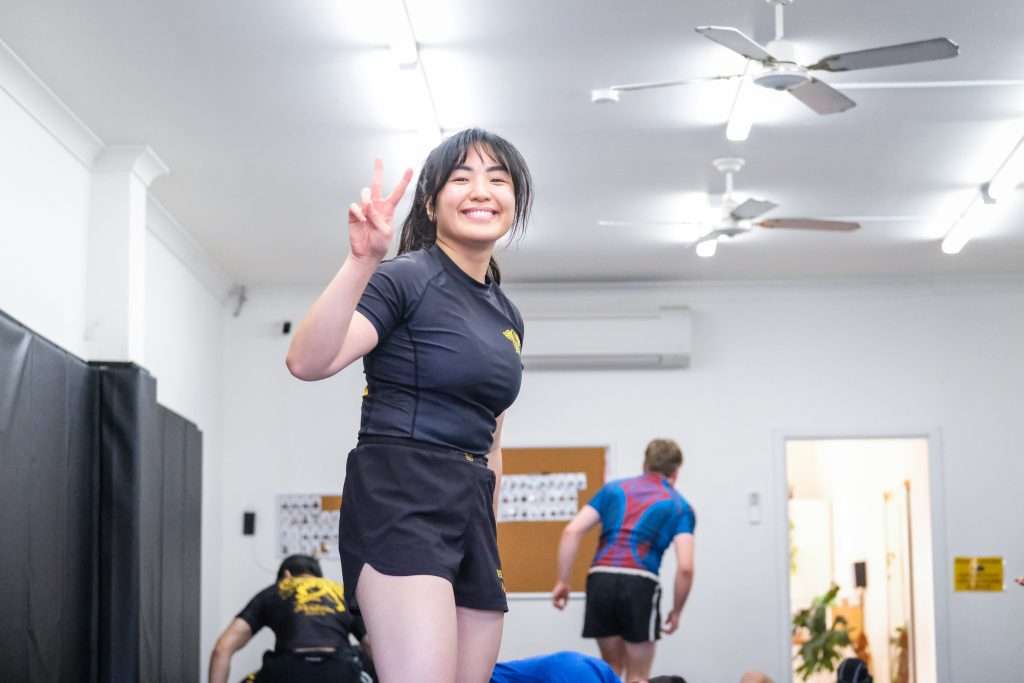
Basic movement drills: Learning how to fall, forward and backward rolls, technical stand-ups. These feel weird at first. Don’t worry about doing them perfectly. Just follow along.
Partner drills: You might pair up for grip fighting or a specific movement pattern. The coach will pair you with someone experienced who can help you.
What you’re thinking: “I look like an idiot. I can’t do this.”
The reality: Everyone looks awkward during warm-ups, even people who’ve been training for years. Shrimping looks ridiculous no matter how good you are at it.
The warm-up is 10-15 minutes. It’s not designed to destroy you. It prepares your body for training.
Technique Instruction (7:20 PM)
The coach demonstrates a technique. Let’s say it’s a basic guard pass.
They break it down step by step. They might demonstrate it 2-3 times, showing different angles and common mistakes.
Then: “Okay, find a partner and drill this.”
This is the moment you panic. Everyone pairs up immediately. You’re standing there alone.
Don’t worry. The coach is watching for this. They’ll either partner with you themselves or pair you with someone reliable who’s good with beginners.
You drill the technique for 5-10 minutes. Your partner will probably go first, showing you the movement. Then it’s your turn. Steps get forgotten. They remind you. Then you try again.
Nobody expects you to get it right the first time. Or the tenth time.
What you’re thinking: “I can’t remember any of this. How does anyone remember this?”
The reality: You won’t remember it. That’s normal. The technique will be shown again in future classes. Repetition over months is how you learn, not memorizing everything in one session.

More Technique or Positional Drilling (7:35 PM)
Depending on the class structure, you might learn a second technique, or do positional sparring (starting from a specific position and working from there).
If it’s positional sparring, the coach explains the scenario: “Person A starts in closed guard, Person B tries to pass. Go for 2-3 minutes, then switch.”
You do this with your partner. They go easy on you. You try things. Most of them won’t work. That’s expected.
Between rounds, the coach might give you specific tips: “Try keeping your elbows tighter” or “Focus on controlling their hips.”
This section lasts 15-20 minutes.
Live Training / Sparring (7:50 PM)
This is where beginners get nervous.
The coach says: “Okay, let’s do some rounds. Five-minute rounds, find a partner.”
Here’s what actually happens on your first day:
You don’t have to spar if you don’t want to. You can sit out and watch. Many beginners do this for their first few classes. It’s completely acceptable.
If you do want to try, tell your partner: “Hey, this is my first class ever. Can we go light?”
Any decent training partner will nod and go very light with you. They’ll let you work. They’ll give you opportunities to try things. They might catch you in a submission. You tap, you reset, you keep going.
If they’re going too hard, you can literally say: “Can we slow it down a bit?” They will.
Rounds are typically 5 minutes. You might do 2-4 rounds depending on the class. You can sit out whenever you need to.
What you’re thinking: “I’m going to get destroyed. Everyone’s going to see how bad I am.”
The reality: Yes, you’re going to get dominated. So is every other beginner. The people watching are either resting between their own rounds or focused on their own training. Nobody’s analyzing your performance.
Cool Down and Class End (8:00 PM)
Class wraps up. Maybe there’s a quick cool-down stretch. Maybe not.
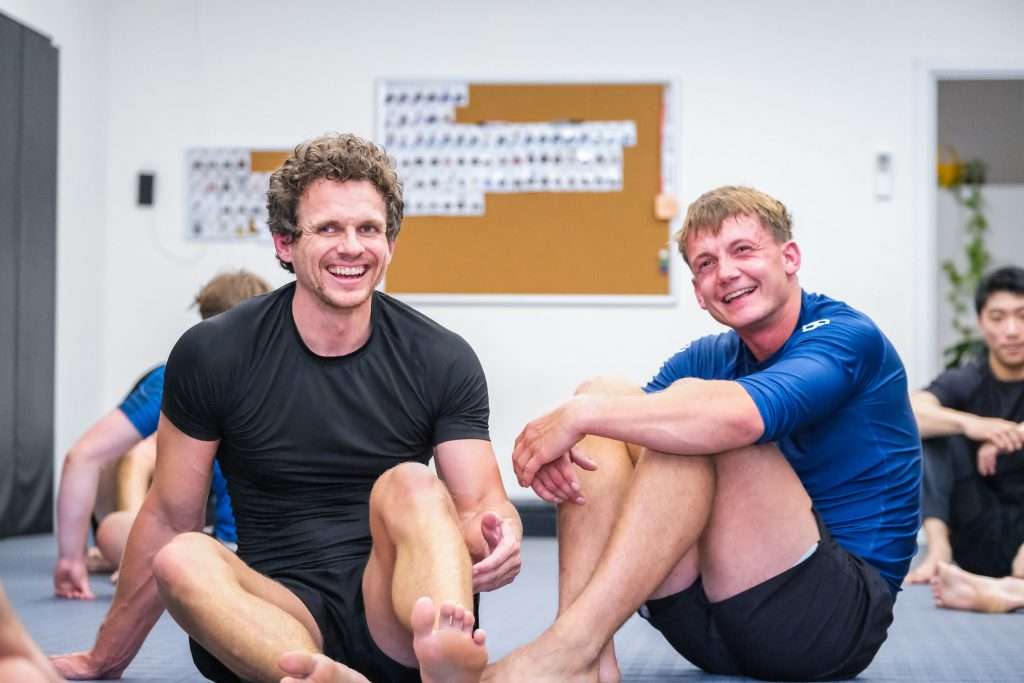
The coach thanks everyone for training. People slap hands, say “good work,” and start packing up.
This is a good time to:
- Thank your training partners
- Ask the coach any questions
- Book your next class
Some people stick around and chat. Some leave immediately. Both are fine.
You walk out sweaty, tired, probably a little overwhelmed, and unsure if you did anything right.
That’s the correct response to your first jiu jitsu class.
What’s Different at Other Gyms in Sydney
The structure I described is specific to Partizan, but most beginner-friendly academies in Sydney follow a similar format:
- Warm-up (10-15 minutes)
- Technique instruction (20-30 minutes)
- Live training or positional sparring (20-30 minutes)
- Total class time: 60-75 minutes
Some gyms do a more traditional bow-in and bow-out. Partizan doesn’t. We’re pretty casual about formalities.
Some gyms require you to wear a gi (the traditional kimono). Partizan is no-gi only, so you wear athletic clothes. If you’re trying a gi class elsewhere, the gym will usually lend you one for your first session.
Some gyms have stricter rules about hygiene, nail length, etc. Partizan expects clean training clothes, short nails, and deodorant to be worn. That’s pretty universal.
The Questions Everyone Asks
“Will I be the only beginner?” Probably not. Most beginner-friendly gyms have a mix of skill levels in every class. Even if you are the only first-timer, there will be other white belts who remember being exactly where you are.
“What if I can’t keep up with the warm-up?” Slow down. Sit out for a moment. Nobody cares. The warm-up isn’t a test.
“What if I forget the technique immediately?” You will. Everyone does. That’s why techniques are repeated across multiple classes. You’re not expected to master anything on day one.
“What if I get paired with someone way better than me?” It’s likely. That’s actually good. They’ll help you learn. Experienced students are usually the best partners for beginners because they have control and can adjust their intensity.
“What if I tap out a lot?” It’s going to happen. That’s called learning. Tapping isn’t losing. It’s paying tuition.
“What if I’m the oldest/least fit/heaviest person there?” At Partizan, we have members ranging from their early 20s to their 50s, with every body type and fitness level imaginable. You’ll fit in fine. If you’re worried about whether you need to be fit before starting, we’ve written about that too.
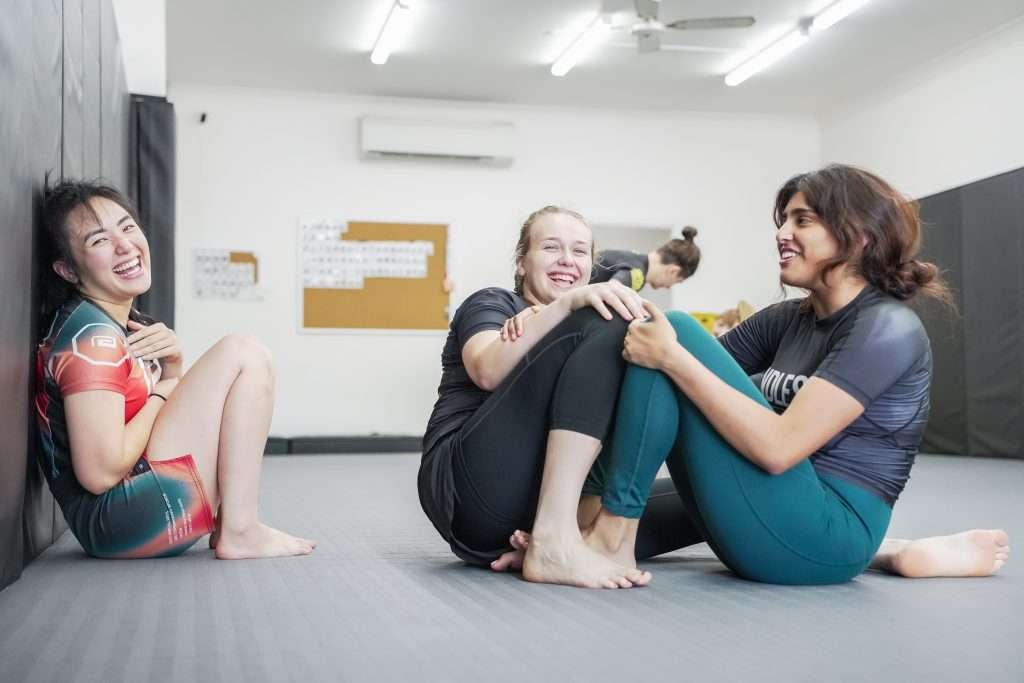
“Will people be weird about me being a woman?” At Partizan, about 30% of our members are women. We run women’s only workshops every Saturday. The culture is explicitly welcoming and respectful. If you ever feel uncomfortable, tell a coach immediately. We take that seriously.
If you’re trying other gyms in Sydney, ask about their female membership percentage and whether they offer women’s classes. That’s usually a good indicator of culture.
What to Do After Your First Jiu Jitsu Class
Don’t overthink your performance. You were bad. Everyone’s bad at first. It doesn’t mean anything about your potential or whether you should continue.
Expect to be sore. You’ll be sore in muscles you didn’t know you had. This lasts for a few weeks, then your body adapts.
Remember one thing you learned. Just one. A concept, a position name, a piece of technique. Write it down. That’s your starting point.
The Beginner Program at Partizan
We have a dedicated Intro to BJJ Program designed specifically for people with less than 3 months of experience. These classes focus on:
- Foundational concepts and mechanics
- Positional control and basic submissions
- How to train safely and communicate with partners
- Building a solid defensive base before worrying about attacks
Classes run multiple times per week, so you can fit them into your schedule whether you work near UNSW, live in the Eastern Suburbs, or commute from elsewhere in Sydney.
After 2-3 months in the intro program, you’ll naturally transition into the all-levels classes where you’ll continue developing your skills alongside more experienced grapplers.
We also offer:
Women’s Only Workshops every Saturday morning. Free and open to members of any gym or affiliation. It’s a collaborative space where women can train together, ask questions, and build skills without any pressure. Learn more about our women’s program.
Kids programs run by Romina Titanti, a judo and BJJ black belt with extensive experience teaching children. If you’re a parent looking to get your kids into grappling, check out our kids program.
The Honest Truth About Your First Jiu Jitsu Class
Your first jiu jitsu class will be uncomfortable.
The warm-ups will feel awkward. Techniques? You’ll forget them immediately. During sparring, expect to get submitted repeatedly. And yes, you’ll be tired.
Walking out, you’ll be thinking: “Did I do okay? Should I come back? Am I cut out for this?”
The answer to all three questions is: it doesn’t matter yet.
You can’t evaluate whether you’re “good” at jiu jitsu after one class. You can’t even evaluate whether you like jiu jitsu after one class. You’re too overwhelmed with new information to form a meaningful opinion.
Come back for class two. Then class three. After 5-6 classes, you’ll have enough context to decide if this is something you want to continue.
But one class? One class just gets you through the door.
What You’re Really Afraid Of
Let’s be honest about what’s actually making you nervous:
You’re not afraid of the physical training. What you’re actually afraid of is looking stupid in front of strangers.
You’re not afraid of getting tired. The real fear is being the person who can’t keep up.
And you’re not afraid of learning techniques. The fear is being bad at something publicly.
I get it. Everyone feels this way before their first class.
Here’s what helps: realize that everyone in that room has been exactly where you are. Every purple belt, every brown belt, every instructor. They all had a first class where they felt incompetent and out of place.
They kept showing up. That’s the only difference between them and you.
The Next Step
You’ve read this far, which means you’re genuinely considering trying a class.
Stop considering. Just book it.
Pick a day this week. Book your free trial at Partizan (or whatever grappling gym in Sydney is closest to you).
Show up 15 minutes early. Wear shorts and a t-shirt. Bring water.
Everything else will be explained when you get there.
In six months, you’ll be the person welcoming the next nervous beginner, remembering exactly how they feel.
I’ll see you on the mats.
Partizan Grappling is located at 381 Anzac Parade, Kingsford, NSW. We’re a 10-minute walk from UNSW and easily accessible by bus (routes 391-396 along Anzac Parade). Book your free trial class here. No experience required.
RELATED ARTICLES: