
You want your child to learn self-defense, build confidence, and develop discipline. You’re comparing martial arts programs in Sydney, and the two options that keep coming up are Brazilian Jiu-Jitsu and Karate.
Here’s the honest answer: both can be good, but they develop completely different skills. One teaches your child to defend themselves in real situations. The other teaches patterns and forms that look impressive but rarely work outside the dojo.
If you want your child to actually be able to protect themselves, BJJ is the better choice. Here’s why.

The Fundamental Difference
Karate: Your child learns to punch and kick in choreographed patterns (called katas). They practice techniques on air or compliant partners. Sparring is limited or uses point-based rules that don’t reflect real confrontations.
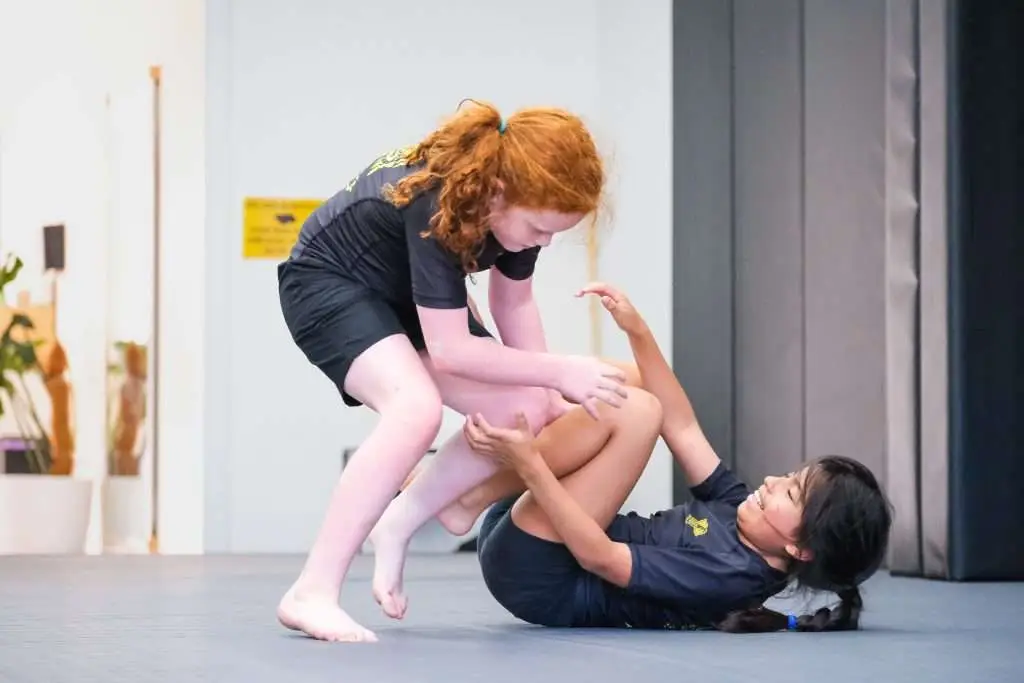
BJJ: Your child learns to control, pin, and submit opponents using leverage and technique. They practice on resisting partners from day one. Every class includes live grappling where techniques either work or they don’t.
The core difference: Karate teaches movements. BJJ teaches problem-solving.
Why BJJ Works Better for Self-Defense
Most fights go to the ground. Research shows 70-90% of real confrontations end up in grappling range or on the ground. Karate prepares kids for the 10% of scenarios that stay standing at striking distance. BJJ prepares them for the 90%.
Size matters less in grappling. A smaller child who knows BJJ can control a larger, stronger opponent using leverage and technique. In striking martial arts, the bigger, stronger kid usually wins. This is especially important for smaller kids or girls.
Your child learns against resistance. In BJJ, kids grapple (roll) with partners who are actively trying to resist and escape. They learn what actually works under pressure. In Karate, kids practice on compliant partners or punch air. This doesn’t prepare them for an actual confrontation.
No striking means safer training. Kids can practice BJJ at full intensity without getting hurt. They’re not getting punched in the face or kicked in the ribs. They tap when caught, reset, and go again. This means more realistic training with less injury risk.
Immediate feedback. When your child attempts a technique in BJJ, they immediately know if it worked. Their partner either gets controlled or escapes. In Karate, there’s no real feedback loop. Did that kick “work”? Maybe. Did that kata look right? Who knows.
What About Discipline and Respect?
This is where parents get it wrong. They think traditional martial arts like Karate teach discipline better than BJJ because of the bowing, uniform requirements, and formal structure.
Reality: Discipline comes from consistent training, clear expectations, and genuine challenge. Not from bowing and wearing a specific uniform.
BJJ develops discipline through:
- Consistent training schedule (kids learn to show up even when they don’t feel like it)
- Immediate consequences (if they don’t pay attention or try hard, they get tapped during rolling)
- Progressive skill development (they see measurable improvement over time, which builds work ethic)
- Respecting training partners (they learn to control intensity and tap their partners safely)
Your child will respect the sport that challenges them authentically, not the sport that just makes them bow more.
Bullying: Which Actually Helps?
If your child is being bullied or you want them prepared for potential bullying, BJJ is significantly more practical.
Why BJJ works for bullying:
- Most school bullying involves pushing, grabbing, and wrestling. Exactly what BJJ teaches.
- Your child can control a bully without striking them (important for avoiding school discipline)
- BJJ teaches defensive positions and escapes first. Your child learns to protect themselves, not attack.
- The confidence from knowing they can handle themselves physically often prevents confrontations entirely
Why Karate falls short:
- Punching or kicking a bully will get your child suspended, even in self-defense
- Kata practice doesn’t prepare kids for the chaos of an actual confrontation
- Point-sparring rules don’t translate to real situations
The uncomfortable truth: A child who’s been doing BJJ for 6 months can handle most untrained kids regardless of size. A child who’s been doing Karate for 2 years might know impressive forms but will struggle in an actual physical confrontation.
Physical Development: What Each Sport Builds
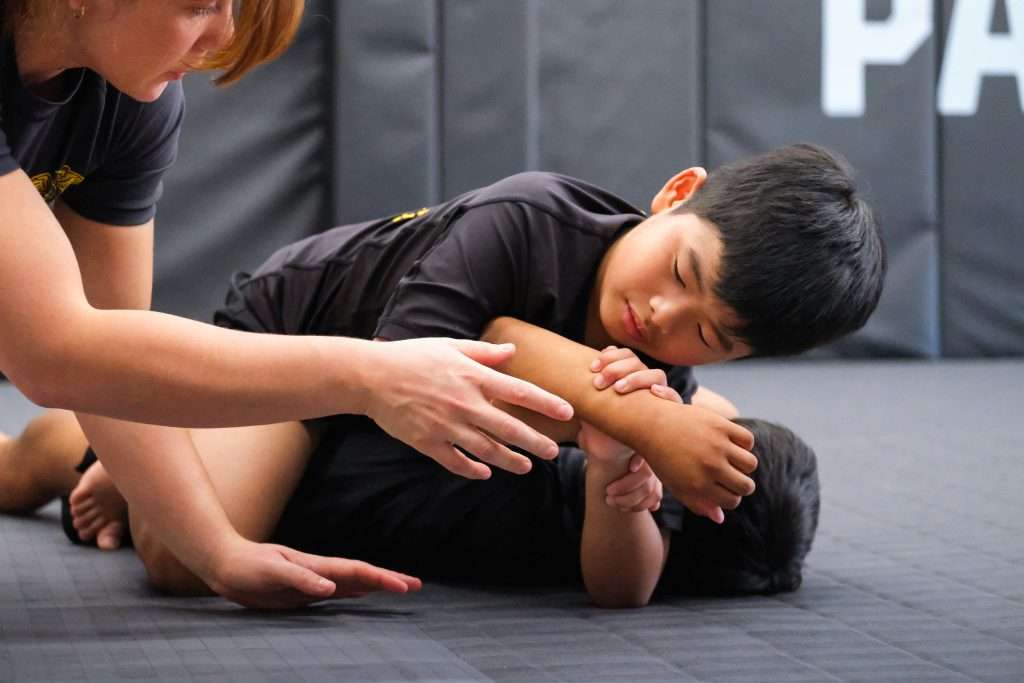
BJJ develops: Full-body functional strength, cardiovascular endurance, flexibility and body awareness, core strength and balance, and scrambling skills that translate to other sports.
Karate develops: Explosive power, flexibility (especially high kicks), coordination and rhythm, speed and reaction time, and formal movement patterns.
Both are good exercise. BJJ tends to build more practical, functional fitness that translates to other sports and activities.
The Social Environment
BJJ culture: Friendly, ego-free environment (getting tapped keeps everyone humble). Strong bonding through shared struggle. Inclusive regardless of size, gender, or athletic ability. Training partners actively help each other improve.
Traditional Karate culture: More hierarchical with clear instructor-student divide. Focus on individual performance and perfection. Formal etiquette and traditional Japanese customs.
Neither is inherently better, but BJJ’s collaborative culture tends to work better for modern kids. They’re solving problems together rather than following orders and memorizing forms.
Cost Comparison (Sydney Context)
Karate: $100-180/month plus uniform ($50-100), belt gradings every 3-6 months ($50-100 each), and potential mandatory seminars ($50-200).
BJJ: $150-225/month plus gi ($80-150 to start). Quality gyms include grading fees in membership.
At Partizan Grappling, kids programs run $49 per week, with no grading fees, no contracts, and no mandatory purchases beyond basic training gear.
Age Considerations
Both can work for young kids (5-6), but BJJ’s hands-on, interactive nature often keeps younger kids more engaged than standing in lines practicing kicks.
For older kids (10+): BJJ has a clear advantage. Pre-teens and teens want to learn practical skills, not perform forms. They’re also old enough to appreciate the strategic elements of grappling.
What About Striking Skills?
Valid concern: “But what if my child needs to defend against punches?”
Reality: Most self-defense situations for kids happen at close range (grappling distance), not at punching/kicking distance. School bullying involves pushing, grabbing, tackling. Not boxing matches.
If you want your child to learn striking for self-defense, they can always add it later. But a child who only knows striking and doesn’t know grappling will lose to any child who knows how to wrestle or grapple. The opposite isn’t true.
Making the Decision
Choose BJJ if:
- You want practical self-defense that actually works
- Your child is being bullied or you want them prepared for physical confrontations
- You value problem-solving and strategic thinking
- Your child is smaller than their peers (technique beats size in BJJ)
Choose Karate if:
- You value traditional martial arts culture and etiquette
- Your child loves performing and demonstration
- You’re not primarily concerned with practical self-defense
Most kids gravitate toward one or the other naturally. BJJ kids love problem-solving and the physical challenge. Karate kids love structure and perfecting movements.
The Honest Bottom Line
For practical self-defense: BJJ wins decisively. Your child will learn to protect themselves in real situations.
For bullying prevention: BJJ is significantly more practical and doesn’t require striking (which gets kids suspended).
For long-term engagement: BJJ’s problem-solving nature tends to keep older kids (10+) more engaged than repetitive kata practice.
If you want your child to actually be able to defend themselves, build genuine confidence, and develop problem-solving skills, BJJ is the better choice.
If you value traditional martial arts culture and don’t prioritize practical self-defense, Karate can work fine.
But if you’re choosing based on what will actually keep your child safe and confident, there’s no comparison. BJJ works. Karate looks impressive.
Next Steps
The best way to decide is to try both. Most gyms offer free trial classes.
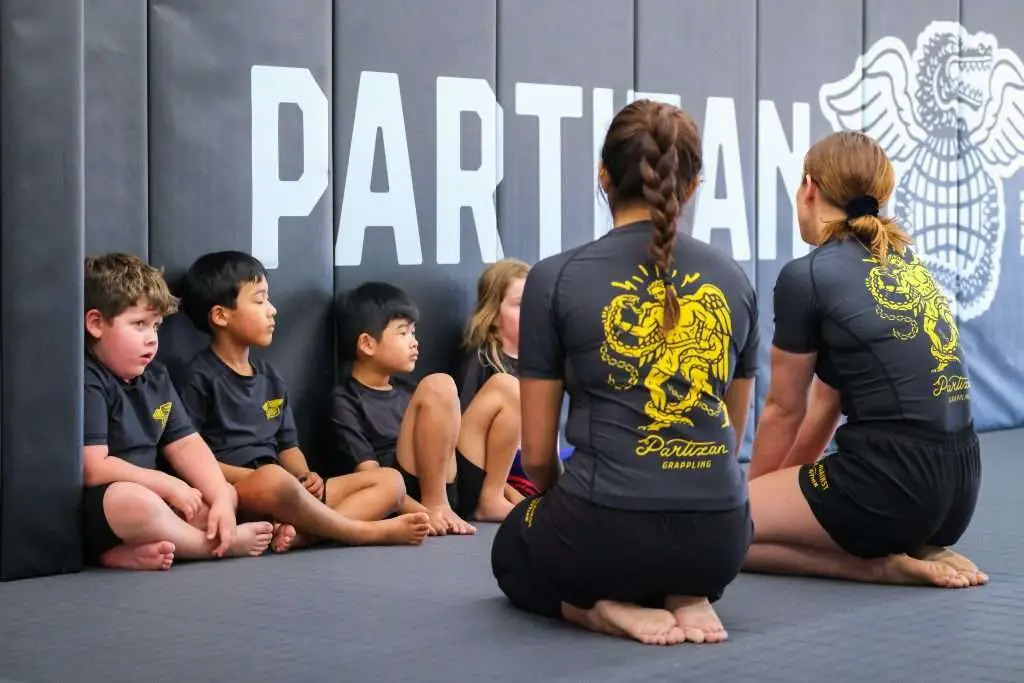
At Partizan Grappling, we offer kids classes for juniors (5-10) and teens (10-15) with no contracts and no pressure. Your child can try a class for free and see if they enjoy it.
Ready to see if BJJ is right for your child? Book a free trial class at Partizan Grappling in Kingsford. No contracts, no grading fees, just quality instruction in a supportive environment.