
Two to three times per week. That’s the answer.
Not once. Not five times. Two to three times per week for the first 6-12 months.
I know that’s not what you wanted to hear. You’re excited. You want to train every day. Furthermore, you want to get good fast.
However, after coaching hundreds of beginners at Partizan Grappling over the past two years, I can tell you with absolute certainty: the beginners who train 2-3 times per week for a year make more progress than the ones who train 5-6 times per week for three months and then burn out.
Let me explain why, and then give you the framework for deciding your optimal training frequency.
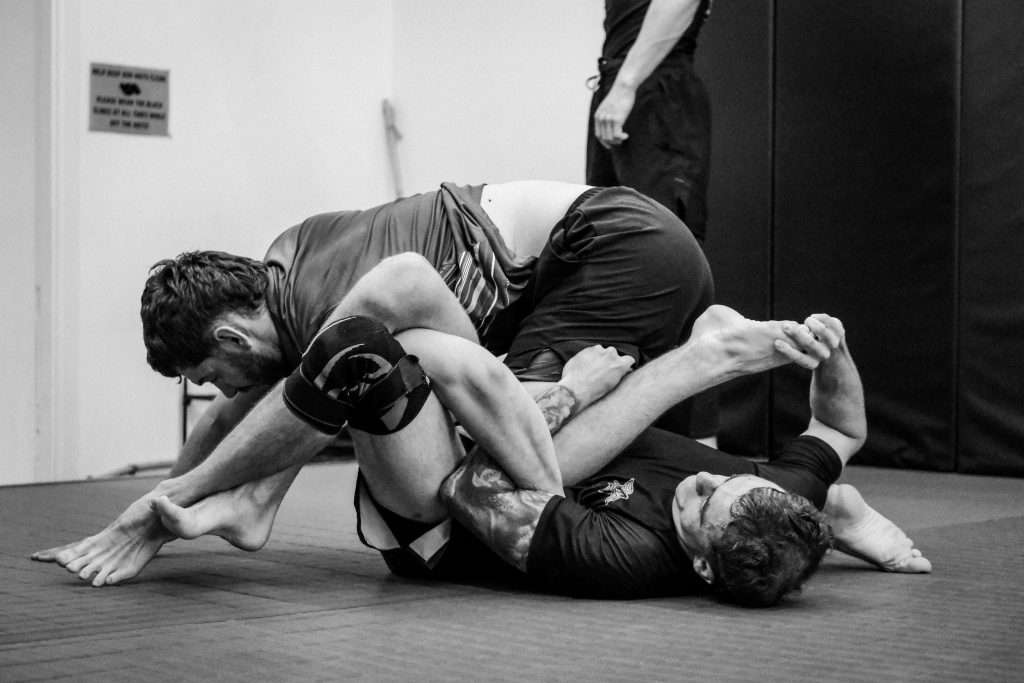
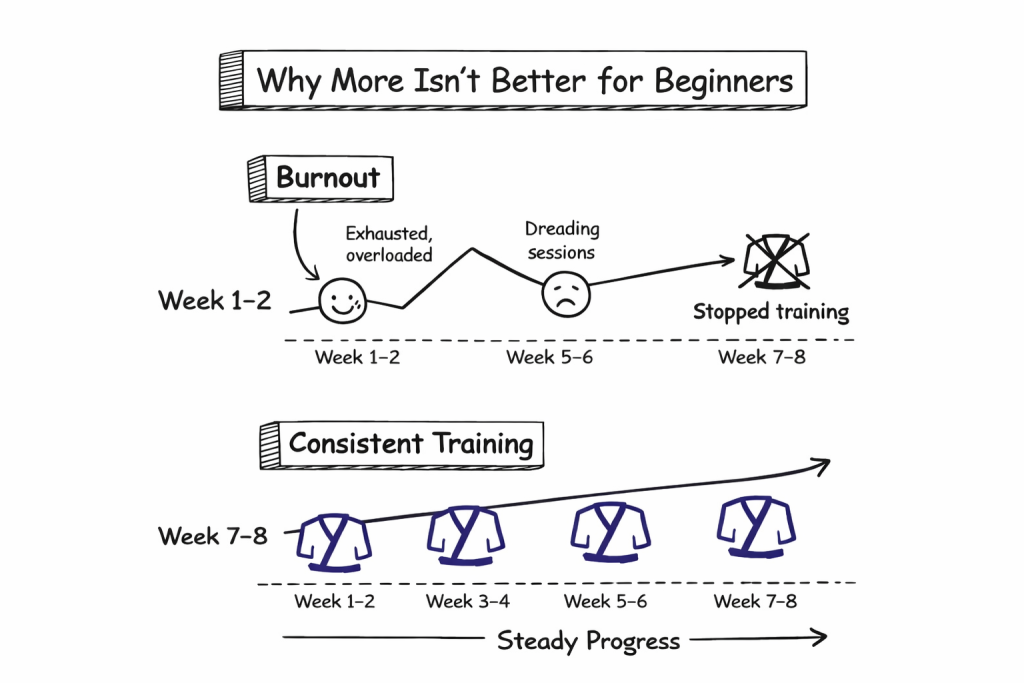
Why More Isn’t Better for Beginners
Here’s what happens when beginners overtrain:
Week 1-2: You’re excited. You train four or five times. Your body is destroyed but you’re motivated by novelty.
Week 3-4: Everything hurts. You’re exhausted. You’re mentally fried from processing so much new information. Despite this, you push through because you don’t want to be a quitter.
Week 5-6: Training stops being fun. Instead, it’s become an obligation. You’re dragging yourself to class. Consequently, you start making excuses to skip sessions.
Week 7-8: You train once, maybe twice. Then you stop going entirely.
Meanwhile, the person who trained twice per week from day one is still showing up six months later. They’re making steady progress and actually enjoying the process.
Training frequency isn’t about how much you can handle short-term. Rather, it’s about building a sustainable habit long-term.
What Happens When You Train Too Much
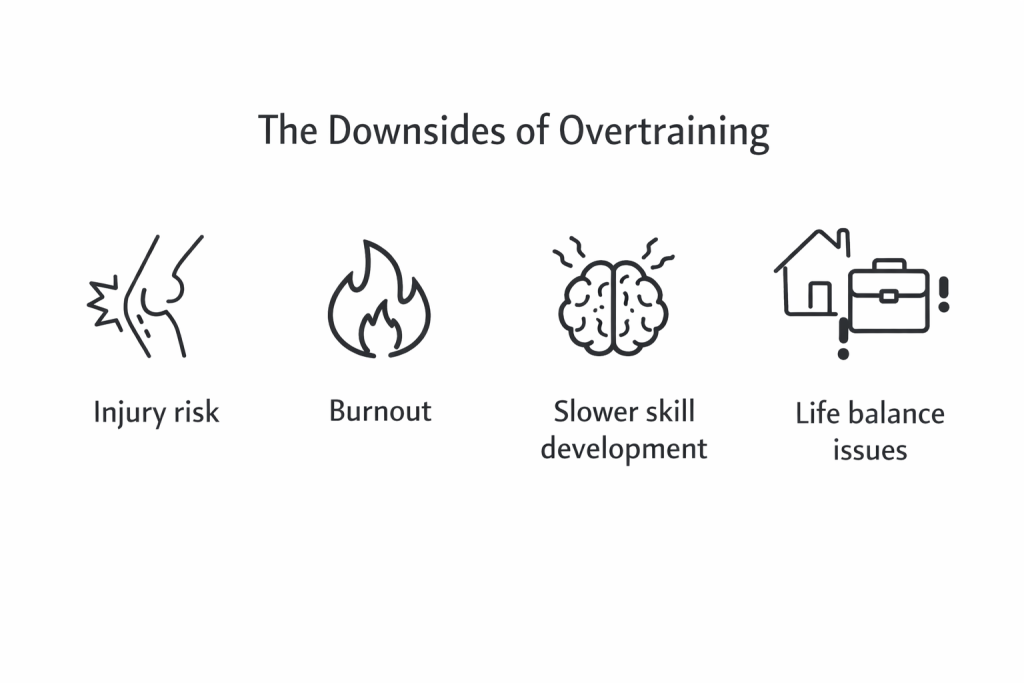
Let me be specific about the consequences of overtraining as a beginner:
1. Increased Injury Risk
When you’re exhausted, your technique breaks down. You rely on strength instead of leverage. As a result, you get hurt or hurt others. I’ve seen exhausted beginners tweak joints or strain muscles because they were too tired to move properly.
2. Slower Skill Development
Counter-intuitive but true: training too often can actually slow your progress. When you’re mentally fried, you can’t absorb new information. The beginner who trains fresh twice per week retains more information than the beginner who trains exhausted five times per week.
3. Burnout
This is the big one. The primary reason beginners quit BJJ isn’t because it’s too hard. Instead, it’s because they burned themselves out in the first 2-3 months. They trained too much, too soon. It stopped being fun. Sustainable progress beats explosive progress that fizzles out.
4. Life Balance Issues
If you’re training 5-6 times per week, what are you sacrificing? Time with family? Your career performance? Other hobbies?
This creates resentment. Two to three sessions per week is sustainable. In contrast, five to six sessions per week requires sacrifices most people can’t maintain long-term.
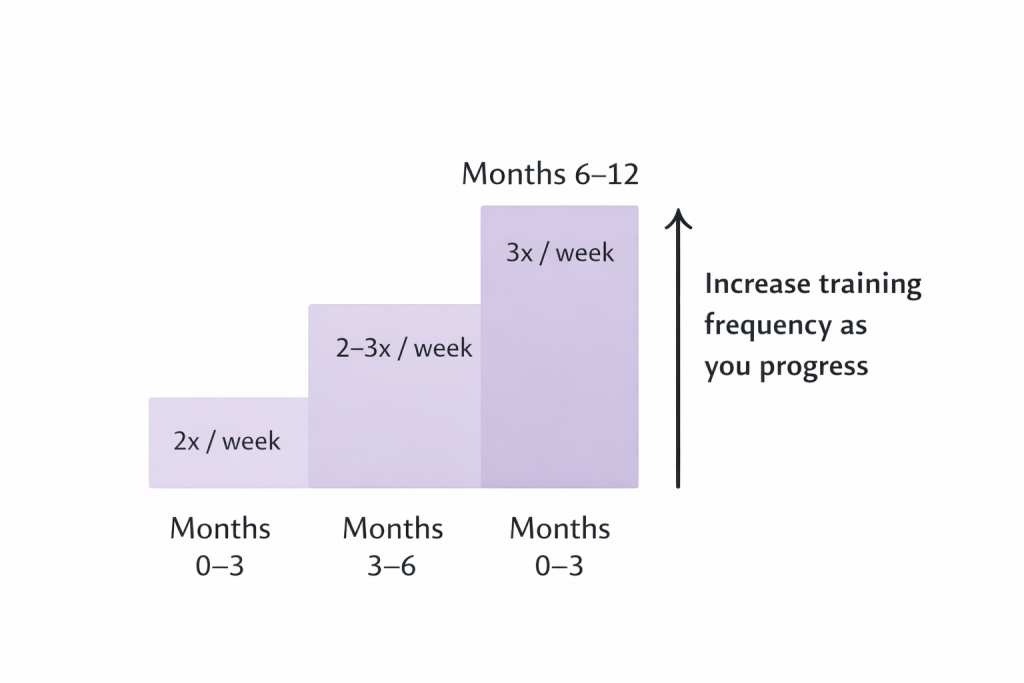
The Optimal Training Frequency by Timeline
Here’s my recommendation based on experience coaching hundreds of beginners:
Months 0-3: Two Times Per Week
Why: Your body is adapting to entirely new demands. You’re sore constantly. Furthermore, you’re processing massive amounts of new information. Two sessions gives you adequate recovery.
What this looks like: Pick two consistent days, such as Tuesday and Thursday. Block them off. Make them non-negotiable. If you’re just starting out, consider our Introduction to BJJ program, which is specifically designed for complete beginners.
Common mistake: Training four times the first week, then being too sore to train at all the second week. Remember, consistency beats intensity.
Months 3-6: Two to Three Times Per Week
Why: Your body has adapted. You’re not as sore. You’re starting to understand basic concepts. Therefore, you can handle a third session if you want.
What this looks like: Keep your two core days. Add a third session on the weekend or a weeknight when your schedule allows.
Key point: The third session is optional. If life gets busy, protect your two core sessions. Don’t sacrifice consistency for volume.
Months 6-12: Three Times Per Week
Why: You’re not a complete beginner anymore. Your body can handle more volume. Additionally, you’ve built the habit. Three sessions per week provides enough frequency to make solid progress. At this stage, you might be ready for our Grappling All Levels classes.
What this looks like: Three consistent sessions per week becomes your baseline. Some weeks you do four if you’re feeling good. Alternatively, some weeks you do two if life is chaotic.
Flexibility matters: Life happens. Kids get sick. Work gets busy. Don’t stress about hitting exactly three every single week. Instead, average three per week over a month.
Year 1+: Three to Four Times Per Week
Why: You’re a solid white belt or approaching blue belt. You’ve built work capacity. Moreover, you genuinely enjoy training and want to be there more often.
What this looks like: Three to four sessions per week consistently. Maybe five occasionally if you’re preparing for competition or have extra time.
Important: Even at this stage, taking rest days matters. Elite competitors train 6+ times per week, but they’ve spent years building that capacity. Don’t compare yourself to them.
How to Know If You’re Training Too Much
Watch for these warning signs:
Physical Indicators:
- Chronic soreness that doesn’t improve between sessions
- Increased susceptibility to minor injuries
- Constant fatigue, even on non-training days
- Sleep quality declining despite being physically tired
- Getting sick more frequently (suppressed immune system)
Mental Indicators:
- Dreading training sessions instead of looking forward to them
- Difficulty concentrating during technique instruction
- Not retaining anything you learn in class
- Irritability and mood swings
- Training feels like an obligation rather than something you enjoy
Performance Indicators:
- Your technique is getting worse, not better
- You’re relying on strength and toughness instead of skill
- You can’t remember what you worked on last week
- You’re getting submitted by people you used to be competitive with
If you’re experiencing multiple indicators from this list, you’re training too much. Scale back to 2x per week for a month and see if things improve.
Quality Over Quantity: What Actually Matters
Here’s something most beginners don’t understand: showing up matters more than how hard you train.
Two focused, technical sessions per week beats four exhausting sessions where you’re just surviving.
What makes a quality training session: You’re mentally present and paying attention. You’re training at appropriate intensity, not going 100% every round. You ask questions and seeking feedback. You recover properly between sessions.
One high-quality session per week is better than five low-quality sessions where you’re just going through the motions.
The Role of Open Mats and Extra Training
Open mats are great for experienced students. For beginners, however, they’re tricky.
They offer more sparring time and a relaxed atmosphere, but lack structure and instruction. They can also be intimidating if you’re the least experienced person.
My recommendation: For your first 6 months, focus on regular classes with instruction. After that, add open mats occasionally if you want more mat time and you’re recovering well.
How to Structure Your Training Week
Here’s what an ideal beginner training week looks like. Check our class timetable to find session times that work with your schedule.
Two Sessions Per Week (Months 0-3)
- Tuesday: Technique class with drilling and light sparring
- Rest day Wednesday
- Rest day Thursday
- Friday: Technique class with drilling and light sparring
- Rest Saturday-Monday
Total weekly volume: 2-3 hours of actual training
Three Sessions Per Week (Months 3-12)
- Tuesday: Technique class
- Rest Wednesday
- Thursday: Technique class
- Rest Friday
- Saturday: Technique class or open mat (women can join our Women’s Workshop)
- Rest Sunday-Monday
Total weekly volume: 3-4.5 hours of training
This structure gives you 48-72 hours between sessions for recovery while maintaining consistency.
Special Considerations
Work schedules: Pick consistent days that work for you. If your schedule varies, be flexible but maintain the frequency.
Injuries: Minor injuries? Keep training but modify intensity. Moderate injuries? Take a week off and let it heal. Serious injuries? Follow medical advice and return gradually.
Competition prep: Don’t compete in your first 6 months. When you do, don’t dramatically increase volume. Better to be slightly undertrained than injured.
The Consistency Principle
Here’s the most important thing I can tell you about training frequency:
Two sessions per week for 52 weeks beats four sessions per week for 20 weeks.
The beginners who are still training two years later aren’t the ones who trained most intensely. Instead, they’re the ones who built a sustainable habit they could maintain through busy work periods, family obligations, minor injuries, and life chaos.
They didn’t rely on motivation or discipline. Instead, they built a routine that was easy to maintain even when life got hard.
That’s what two to three times per week gives you: sustainability.
What Success Actually Looks Like
After one year of training 2-3 times per week consistently, you’re a competent white belt who can defend yourself effectively. You understand fundamental positions, have techniques that work for you, and have built genuine friendships. Training is a habit you don’t question. You’re not injured or burned out, and you still genuinely enjoy it.
Compare this to training 5-6 times per week: after six months you might have similar technical skills, but you’re exhausted, probably carrying injuries, you’ve neglected other parts of your life, and there’s a good chance you’re about to quit.
Which path sounds better?
How to Actually Implement This
If you’re starting jiu jitsu or struggling with training frequency, here’s your action plan:
1. Pick two specific days and times. Tuesday 6 PM and Thursday 6 PM, for example. Block them in your calendar like doctor’s appointments.
2. Commit to 12 weeks minimum. Don’t evaluate if it’s “working” before then. Just show up twice per week for 12 weeks.
3. Track your attendance. Use a simple habit tracker. Mark an X every time you train. Watch the X’s accumulate.
4. Protect your two core sessions. If you have to miss one, fine. But never skip both sessions in a week unless you’re sick or injured.
5. Resist the urge to add more. For the first three months, stick with two sessions. When you want to train more, remind yourself you’re building a long-term habit.
6. Add a third session after 3-6 months. Once two sessions per week feels easy and automatic, add a third. Give your body a month to adjust.
7. Listen to your body. If you’re constantly sore, exhausted, or dreading training, scale back. If you feel great and want more, add gradually.
The Bottom Line
Train two to three times per week for your first year.
This will feel too slow. You’ll see other people training more. Naturally, you’ll think you should do the same.
Ignore them. They’re probably going to quit.
You’re playing the long game. In five years, you’ll be a purple or brown belt who still loves training. Meanwhile, most of the people who trained five times per week in their first year will be gone.
Consistency over intensity. Sustainability over speed. Long-term success over short-term gains.
Two to three times per week gives you all of that.
I’ll see you on the mats.
Ready to Start Training Smart?
If you’re looking for a grappling academy in Sydney with flexible class schedules that accommodate 2-3 sessions per week, Partizan Grappling in Kingsford offers multiple class times throughout the week for beginners. We prioritize sustainable training habits over burnout-inducing intensity.
No contracts. No joining fees. Definitely no mandatory uniforms. Just high-quality training in a beginner-friendly environment near UNSW.
Or view our class timetable and pricing to learn more.