
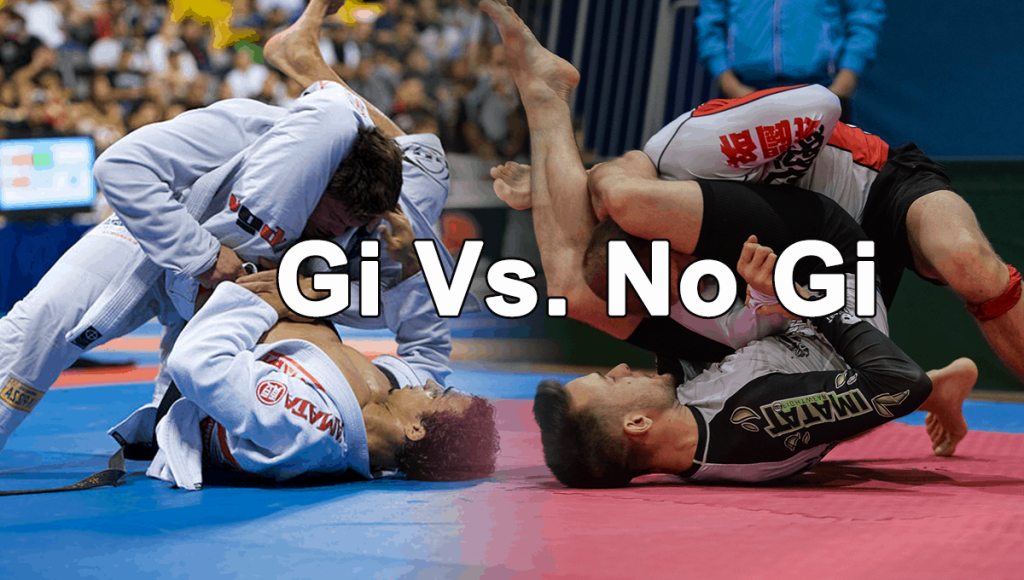
If you ask most traditional BJJ instructors, they’ll tell you beginners should start with gi training.
My take? That’s outdated advice based on tradition, not logic.
I run a no-gi-only grappling academy in Sydney. Yes, I’m biased. However, I’m also going to explain why the “start with gi” advice exists, why it made sense historically, and why it’s no longer the best recommendation for most beginners in 2024.
Then you can make your own informed decision.
What’s the Difference?
Let’s start with the basics.
Gi training (also called traditional BJJ) involves wearing a heavy cotton uniform: a jacket, pants, and belt. You can grab and control your opponent using their gi, with grips on the collar, sleeves, and pants forming the foundation of the game.
No-gi training involves wearing athletic clothes: rashguards, shorts, or spats. Without fabric to grab, you control your opponent using body-to-body grips, overhooks, underhooks, and wrestling-style controls.
Both are jiu jitsu. Both teach the same fundamental concepts of leverage, timing, and positional control. The techniques overlap by about 70-80%. The difference? How you grip and control your opponent.
Why People Say “Start with Gi”
The traditional argument for gi training goes like this:
1. “The gi slows the game down, making it easier to learn”
When you can grab someone’s gi, the pace naturally slows. Grips create friction, which theoretically gives beginners more time to think and problem-solve.
2. “You learn better grips and control”
Gi training forces you to develop strong grip fighting skills. Understanding how to establish and break grips translates to all forms of grappling.
3. “It’s more technical and less reliant on athleticism”
The gi theoretically neutralizes athletic advantages, forcing everyone to rely on technique rather than speed or strength.
4. “That’s how BJJ has always been taught”
Brazilian Jiu Jitsu came from judo. Judo uses a gi. Therefore, “proper” BJJ should start with gi training, or so the logic goes.
These aren’t wrong arguments. They’re just incomplete.
The Real Reason Gyms Push Gi for Beginners
Here’s what nobody tells you: most BJJ gyms have structured gi programs for beginners because of tradition and business logistics, not because it’s pedagogically superior.
Historically, BJJ was taught in a gi because that’s how it came from Brazil. Early academies built their entire curriculum around gi training, with beginner programs designed exclusively for gi instruction.
When no-gi became popular (largely due to MMA and submission grappling competitions), gyms added no-gi classes as an advanced option. The narrative became: “Do gi first, then you can try no-gi when you’re better.”
This created a self-fulfilling prophecy. If all your beginner-focused instruction happens in gi classes, then of course beginners develop faster in gi classes.
But that’s a curriculum design choice, not an inherent truth about learning grappling.
Why No-Gi Is Actually Better for Most Beginners
Let me make the case for starting with no-gi:
1. Lower barrier to entry
Gi: You need to buy a gi (often $80-150 for a decent one). You need to learn how to tie your belt properly. Additionally, you need to wash and maintain heavy cotton fabric that takes forever to dry. You look and feel like you’re wearing a karate costume.
No-gi: You wear athletic shorts and a t-shirt. things you already own. If you decide to buy proper gear later, rashguards and shorts cost $30-60 total. You throw them in the washing machine with your normal clothes.
For someone unsure if they’ll stick with grappling, no-gi removes a $100+ commitment barrier.
2. It’s more intuitive
Here’s an uncomfortable truth: gi grips don’t exist in real life.
If you need to defend yourself, your attacker isn’t wearing a thick cotton jacket with a collar and sleeves designed for gripping. They’re wearing a t-shirt, a hoodie, or a tank top instead.
No-gi translates immediately if you transition to MMA or want practical self-defense skills. Gi techniques, on the other hand, require adaptation.
No-gi feels more natural to beginners because the controls mirror real-world scenarios: grabbing someone’s wrist, controlling their head, underhooking their arm. These are intuitive human movements that don’t require specialized knowledge of fabric manipulation. If you’re wondering what a typical class looks like, check out what to expect in your first jiu jitsu class.
3. Less overwhelming information
In gi, beginners need to learn:
- How to grip the gi properly
- Which grips are strong and weak
- How to break different grip configurations
- Collar chokes (dozens of variations)
- Sleeve control strategies
- Pant grip positioning
- Plus all the fundamental positions and submissions
In no-gi, beginners learn:
- Fundamental positions and submissions
- Body-to-body controls
- Wrestling-style grips
The cognitive load is significantly lower. You can focus on the core concepts of jiu jitsu without the added layer of gi-specific technique.
4. Faster pace develops better habits
Yes, no-gi is faster. That’s actually a feature, not a bug.
In gi, beginners can stall by holding grips. They can pause mid-position and rest while maintaining collar control, which can hide gaps in their understanding.
In no-gi, you can’t rely on grips to bail you out. If your positional control is weak, your opponent escapes. This forces you to develop tighter, more effective technique from day one.
The speed of no-gi also develops better cardiovascular conditioning. Moreover, it teaches you to stay calm under pressure, both crucial skills for real grappling.
5. Less injury risk from grip fighting
Gi training is notorious for finger injuries. Gripping heavy fabric repeatedly, having your grips stripped aggressively, jamming fingers into lapels, it’s rough on your hands.
Google “BJJ finger injuries” and you’ll find endless discussions of cauliflower fingers, arthritis, and permanent joint damage.
No-gi isn’t injury-free, but the injury profile is different. You’re not chronically straining your finger joints from grip fighting. For beginners who want to train long-term without accumulating hand damage, no-gi is gentler on the body. Plus, if you’re curious about whether you need to be fit before starting BJJ, the answer is no. No-gi training will get you in shape as you learn.
6. It’s what modern grappling is moving toward
Look at the highest-level grappling competitions:
ADCC (the most prestigious grappling tournament in the world) is no-gi. The rise of submission-only events like Who’s Number One, Polaris, and Fight to Win? Predominantly no-gi.
MMA is obviously no-gi. UFC champions need elite no-gi grappling to compete at the highest level.
Even in pure BJJ, no-gi divisions are growing faster than gi divisions at most tournaments. If you’re starting grappling in 2024, you’re entering a landscape where no-gi is increasingly dominant. Starting with no-gi means you’re learning the most relevant version of the art.
7. Better for diverse body types
Gi grips can dramatically favor certain body types. Long arms make it easier to maintain collar grips, while larger hands can grip fabric more securely.
No-gi is more equalizing. A smaller person with good body positioning can control a larger opponent effectively without relying on fabric grips that might favor physical attributes. Technique becomes the true differentiator.
Ready to try no-gi for yourself? Book a free trial class at Partizan Grappling and experience the difference firsthand.
When Gi Actually Makes Sense
I’m not saying gi training is bad. I’m saying the blanket advice “all beginners should start with gi” is flawed.
Here are scenarios where starting with gi makes sense:
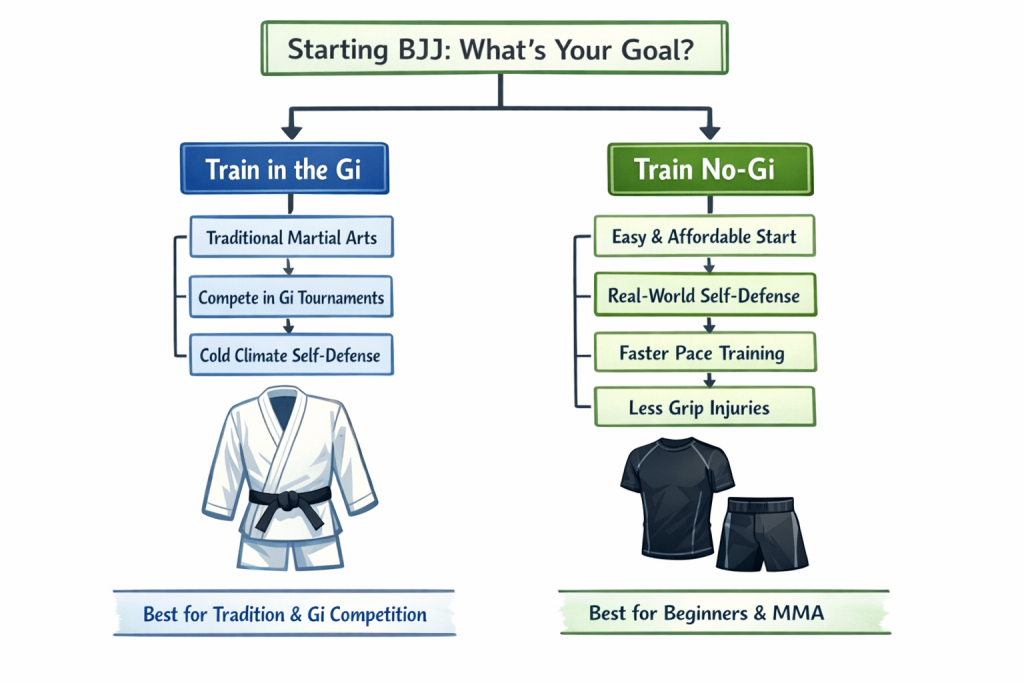
You specifically want to compete in gi divisions. If your goal is IBJJF tournaments or traditional BJJ competition, train in a gi.
You’re training for self-defense in cold climates. If you live somewhere people wear heavy jackets regularly, gi techniques have more real-world application.
You love the traditional martial arts aesthetic. Some people genuinely prefer training in a gi, it feels more like “martial arts” to them. That’s valid.
You have pre-existing joint issues. The slower pace of gi might be better if you need to protect injured shoulders or knees.
The best gym near you is gi-focused. Location and culture matter more than gi vs. no-gi. If there’s an excellent gi school 10 minutes away and the nearest no-gi gym is 45 minutes away, go to the gi school.
[IMAGE: Infographic showing decision tree for gi vs no-gi
What About Wrestling?
If you’re considering no-gi grappling in Sydney, you’ll often find gyms that also teach wrestling alongside BJJ.
Wrestling is an excellent complement to no-gi jiu jitsu. The takedowns, top pressure, and scrambling ability from wrestling translate directly to no-gi grappling.
At Partizan, we incorporate wrestling into our curriculum because it fills the gaps that pure BJJ sometimes misses: aggressive top pressure, takedown systems, and how to not be on your back in the first place. These skills create a more complete grappling game.
If you’re choosing between gi-only BJJ and no-gi BJJ with wrestling elements, the latter gives you a more well-rounded grappling skillset. Plus, the integration between wrestling and no-gi BJJ is seamless in a way that gi and wrestling never quite achieve.
The “Start with Gi” Advice Is Outdated
Twenty years ago, “start with gi” made sense. Almost all BJJ instruction happened in gi, with no-gi being a niche thing competitors did occasionally.
Today, that’s no longer true.
No-gi has its own robust curriculum, coaching methodology, and competition scene. You can become a world-class grappler training exclusively no-gi (see: Gordon Ryan, Garry Tonon, Craig Jones).
The idea that you must start with gi to develop “proper fundamentals” is tradition masquerading as pedagogy. You can learn excellent fundamentals in no-gi. You can develop elite technique in no-gi. Furthermore, you can train for a decade in no-gi and have grappling skills that work everywhere.
What Beginners Should Actually Consider
Instead of “should I do gi or no-gi,” ask yourself these questions:
What’s my goal?
- Self-defense / MMA → No-gi
- Traditional BJJ competition → Gi
- General fitness and fun → Either works
- Becoming a well-rounded grappler → Eventually both, start with whichever is more accessible
What’s available near me?
Check local grappling academies in Sydney. The gym with better culture and proximity matters more than gi vs. no-gi. A great gi gym beats a mediocre no-gi gym and vice versa. If you’re comparing options, our guide to the best BJJ gyms in Sydney for beginners can help you evaluate what matters most.
What’s my budget?
If money is tight, no-gi has lower startup costs. However, if you can afford a gi and want to train in one, go for it. Want to understand the real cost of BJJ in Sydney beyond just the gi? We break down all the expenses you should consider.
What feels right?
Try both if possible. Some people love the gi aesthetic and ritual, while others prefer the simplicity of no-gi. Your gut feeling matters more than internet debates.
Why Partizan Is No-Gi Only
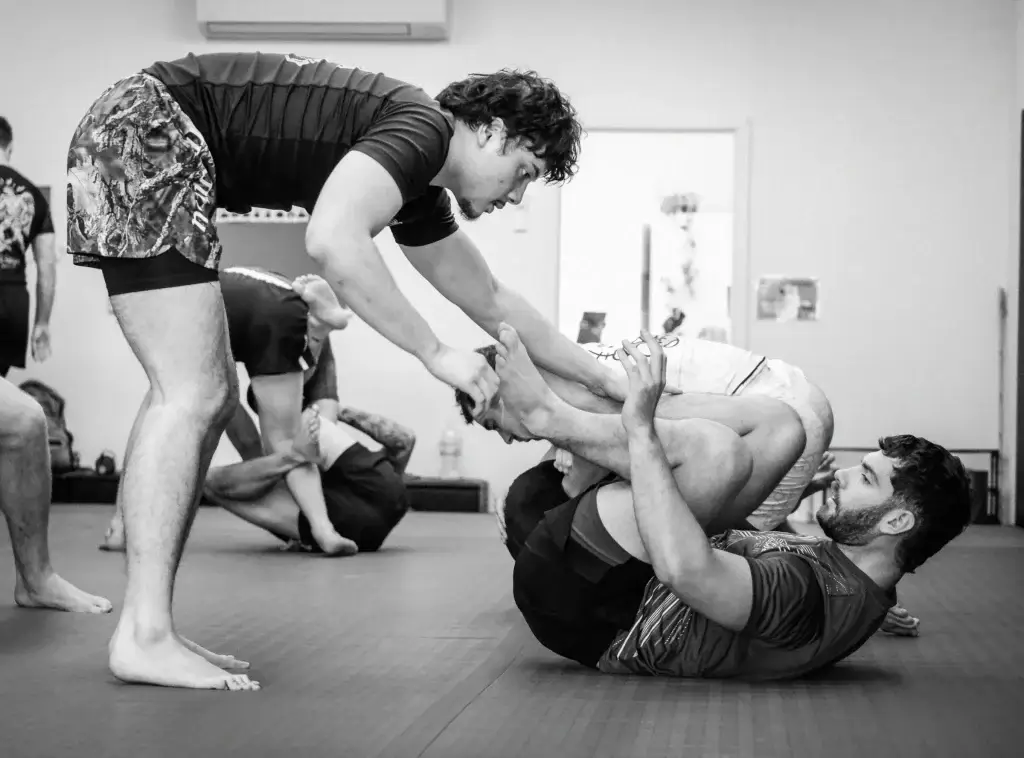
Since I’m being transparent: Partizan Grappling is deliberately no-gi only.
Here’s why we made that choice:
We wanted to do more of what we love. Both Lachlan and I prefer no-gi grappling. Rather than offer both poorly, we chose to excel at one.
We wanted to remove barriers for beginners. No gi purchase required. Show up in athletic clothes and train.
We think it’s more relevant for modern grappling. If someone trains with us for two years and then wants to try MMA, compete in submission grappling, or handle themselves in a real-world situation, they’re prepared.
It aligns with our culture. We’re not interested in the traditional hierarchy and formality that often accompanies gi training. No-gi feels more egalitarian and less dogmatic.
That doesn’t mean gi training is bad. It means we made a deliberate choice about what we wanted to build.
Other gyms made different choices. Some are gi-only, others offer both. There’s no universally correct answer, just different philosophies serving different communities.
The Question You Should Actually Ask
“Should I start with gi or no-gi?” is the wrong question.
The right question is: “Which local grappling gym has the best coaching, culture, and accessibility for me?”
Gi vs. no-gi matters less than:
- Instructor quality
- How welcoming the culture is to beginners
- How close the gym is to your home or work
- Whether you genuinely enjoy training there
If the best gym near you in Sydney happens to be gi-focused, train gi. If it’s no-gi-focused, train no-gi. Moreover, if they offer both, try both and see what you prefer.
Don’t let someone’s dogmatic opinion about gi vs. no-gi prevent you from starting.
The Honest Truth
I genuinely believe no-gi is better for most beginners in 2026.
But I also know plenty of incredible grapplers who started with gi and loved it. I know people who tried no-gi first, hated it, switched to gi, and now train five times per week.
The “best” choice is the one that gets you on the mats consistently.
If wearing a gi makes you feel like a martial artist and motivates you to train, wear a gi. Conversely, if no-gi feels more natural and removes barriers to entry, train no-gi.
Either way, you’re learning jiu jitsu. You’re developing skills that will take years to master. The gi vs. no-gi debate is a footnote compared to the real challenge: showing up consistently for months and years.
Start Somewhere
You’ve read 2,500 words about gi vs. no-gi. You probably have an opinion now.
Good. Act on it.
Find a grappling academy in Sydney, whether gi, no-gi, or both. Book a trial class. Then show up.
Try it for 2-3 months. If you love it, keep going. If you’re curious about the other format, try that too.
But don’t spend another six months researching and comparing. Just start. The analysis paralysis won’t make you better at grappling, mat time will.
The best grapplers aren’t the ones who made the “correct” choice between gi and no-gi. They’re the ones who picked something and showed up consistently for years.
I’ll see you on the mats.
If you’re in Sydney and want to try no-gi grappling, Partizan Grappling in Kingsford offers beginner-friendly classes with no gi purchase required. Just show up in athletic clothes. We also teach wrestling fundamentals as part of our curriculum. Book your free trial class here.
UNSW students: We’re a short walk from campus and offer special student rates. Check out our complete guide for college students getting started with BJJ.